Research Scientist
Google DeepMind, San Francisco
E-Mail: vaishnavh at google.com
He/Him/His
Resume · · · · ·
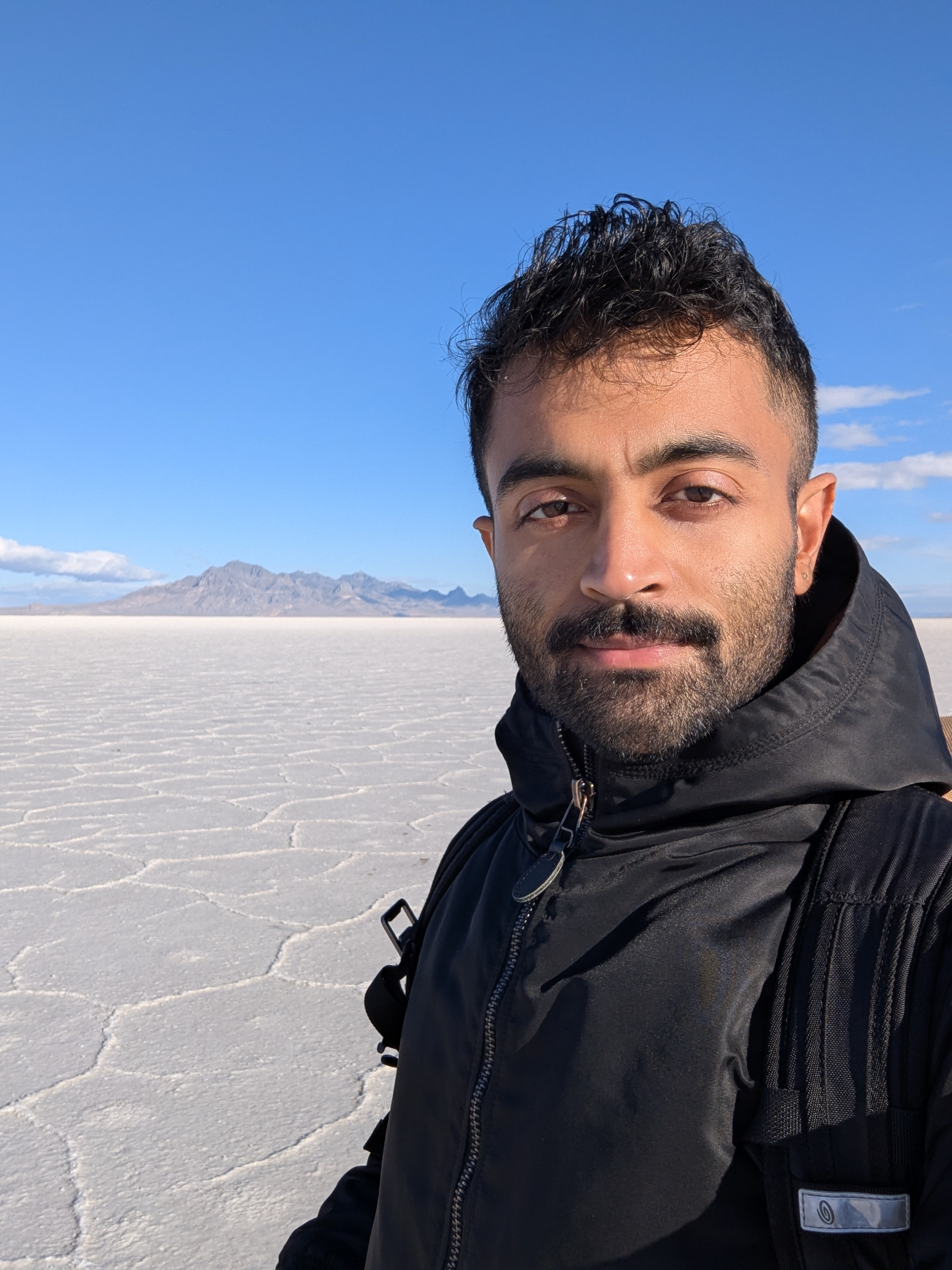
I am a researcher at Google, working on the scientific foundations of AI. Before that I spent six wonderful years (2015-2021) at Carnegie Mellon University, where I earned my PhD in Computer Science, advised by Zico Kolter. I completed my B. Tech in Computer Science at IIT Madras in 2015, where I was advised by Balaraman Ravindran.
I like thinking about when and why complex AI/ML/deep learning systems work or fail. I do this by pursuing minimal abstractions, insightful examples & counterexamples, and simple results. I am currently interested in understanding the limits of and going beyond the next-token prediction paradigm that underlies many current AI models (see this, this or this). My prior works similarly identify examples of failure and success across various settings, including out-of-distribution generalization, generalization bounds and GAN optimization.
My work has been recognized with the Outstanding Paper Award at ICML 2025, the Outstanding New Directions Paper Award at NeurIPS 2019, an Oral presentation at NeurIPS 2017 and a spotlight at ICLR 2021.
Generally, I aspire to write as few papers as needed and instead spend my time on communication, simplifying results, cataloging related work, and peer review. More on my research philosophy which is shaped by what I have read.
I have had the fortune of closely working with and/or mentoring the following students:
- Jayden Teoh (PhD student at MIT as of 2026, interned at Google, hosted by me)
- Shahriar Noroozizadeh (PhD student at CMU as of 2026, interned at Google, hosted by me)
- Chen Henry Wu (PhD student at CMU as of 2025)
- Gregor Bachmann (PhD student at ETH Zürich as of 2024)
- Sachin Goyal (PhD student at CMU as of 2024, interned at Google, hosted by me)
- Jacob Springer (PhD student at CMU as of 2024)
- Yuri Galindo (mentee through Fatima Fellowship)
- Marcus Blake (ML Engineer at Google as of 2025, mentee through Learning Theory Alliance)
- Kimia Hamidieh (PhD student at MIT as of 2024)
- Nuredin Ali (PhD student at Universiy of Minnesota as of 2024)
- Thao Nguyen (PhD student at UW as of 2024)
- Yiding Jiang (PhD student at CMU as of 2024)
- Melrose Roderick (postdoc at Mila as of 2024)
- Jeffrey Li (PhD student at UW as of 2024)
- Deep sequence models memorize geometrically; it’s unclear why,
International Conference on Machine Learning (ICML) 2026,
Shahriar Noroozizadeh, Vaishnavh Nagarajan, Elan Rosenfeld, Sanjiv Kumar
arxiv · poster · talk · code
- Roll the dice and look before you leap: Going beyond the creative limits of next-token prediction,
International Conference on Machine Learning (ICML) 2025,
(Double first author) Vaishnavh Nagarajan*, Chen Henry Wu*, Charles Ding and Aditi Raghunathan
Winner of Outstanding Paper Award
Oral presentation (1% acceptance)
arxiv · poster · oral slides · 1h talk slides · code
- The pitfalls of next-token prediction,
International Conference on Machine Learning (ICML) 2024,
(Double first author) Gregor Bachmann* and Vaishnavh Nagarajan*
arxiv · poster · slides · talk @ Simons Institute · code · faq- Also oral presentation at ICLR ‘24 Workshop “How Far Are We From AGI?”
- Think before you speak: Training language models with pause tokens,
International Conference on Learning Representations (ICLR) 2024,
Sachin Goyal, Ziwei Ji, Ankit Singh Rawat, Aditya Krishna Menon, Sanjiv Kumar, Vaishnavh Nagarajan
arxiv · poster

- Assessing Generalization via Disagreement,
International Conference on Learning Representations (ICLR) 2022,
(Double first author) Yiding Jiang*, Vaishnavh Nagarajan*, Christina Baek, J. Zico Kolter
Accepted for Spotlight presentation, 5.2% acceptance
arxiv · poster
- Understanding the failure modes of out-of-distribution generalization,
International Conference on Learning Representations (ICLR) 2021,
Vaishnavh Nagarajan, Anders Andreassen and Behnam Neyshabur
arxiv · poster · 1h talk · slides
- Uniform convergence may be unable to explain generalization in deep learning,
Neural Information Processing Systems (NeurIPS) 2019
Vaishnavh Nagarajan and J. Zico Kolter
Winner of The Outstanding New Directions Paper Award
Oral presentation, 0.54% acceptance
Also accepted for spotlight talk at:- ICML ‘19 Workshop on Understanding and Improving Generalization in Deep Learning
- IAS/Princeton Workshop on Theory of Deep Learning (recording).
arxiv · oral slides · poster · blogpost · code · errata · faq
- Gradient descent GAN optimization is locally stable,
Neural Information Processing Systems (NeurIPS) 2017
Vaishnavh Nagarajan and J. Zico Kolter
Oral presentation, 1.2% acceptance
arxiv · 1hr talk slides oral slides · poster · 3 min video · code
- Theoretical Insights into Memorization in GANs,
Neural Information Processing Systems (NeurIPS) 2017 - Integration of Deep Learning Theories Workshop
Vaishnavh Nagarajan, Colin Raffel, Ian Goodfellow.
pdf
- Generalization in Deep Networks: The Role of
Distance from Initialization,
Neural Information Processing Systems (NeurIPS) 2017 - Deep Learning: Bridging Theory and Practice
Vaishnavh Nagarajan and J. Zico Kolter.
Spotlight talk
arxiv · poster
- Explaining generalization in deep learning: progress and fundamental limits,
Vaishnavh Nagarajan, 2021
arxiv
I view peer review as a form of tax that should be levied in proportion to how many papers one burdens the system with. If one has the resources to submit a paper on time, they also have the resources to review a proportionate number of papers on time.
- ICML 2025, 2026
- NeurIPS 2025, 2026
- COLM 2025, 2026
- ICLR 2023, 2021 (outstanding reviewer award, top 10%)
- NeurIPS 2024 (top 7%), 2023 (top 10%), 2021, 2020 (top 10%), 2019, (top 50%), 2018 (top 30%)
- ICML 2024 & 2023 (Expert reviewer), 2022, 2021 (Expert reviewer, top 10%), 2020 (top 33%), 2019 (top 5%)
- COLT 2019
- ALT 2021
- UAI 2022
- AISTATS 2023 (top 10%) 2019
- JMLR, Nature
- Workshops:
- ICML: PODS ‘22, OPPO ‘21,
- ICLR-Me-FOMO 2023,
- NeurIPS: DistShift 2023, R0-FoMo 2023 (area chair)
Last Updated: Aug 25 2026
(Beware: sometimes I forget to update the “Last Updated”.)